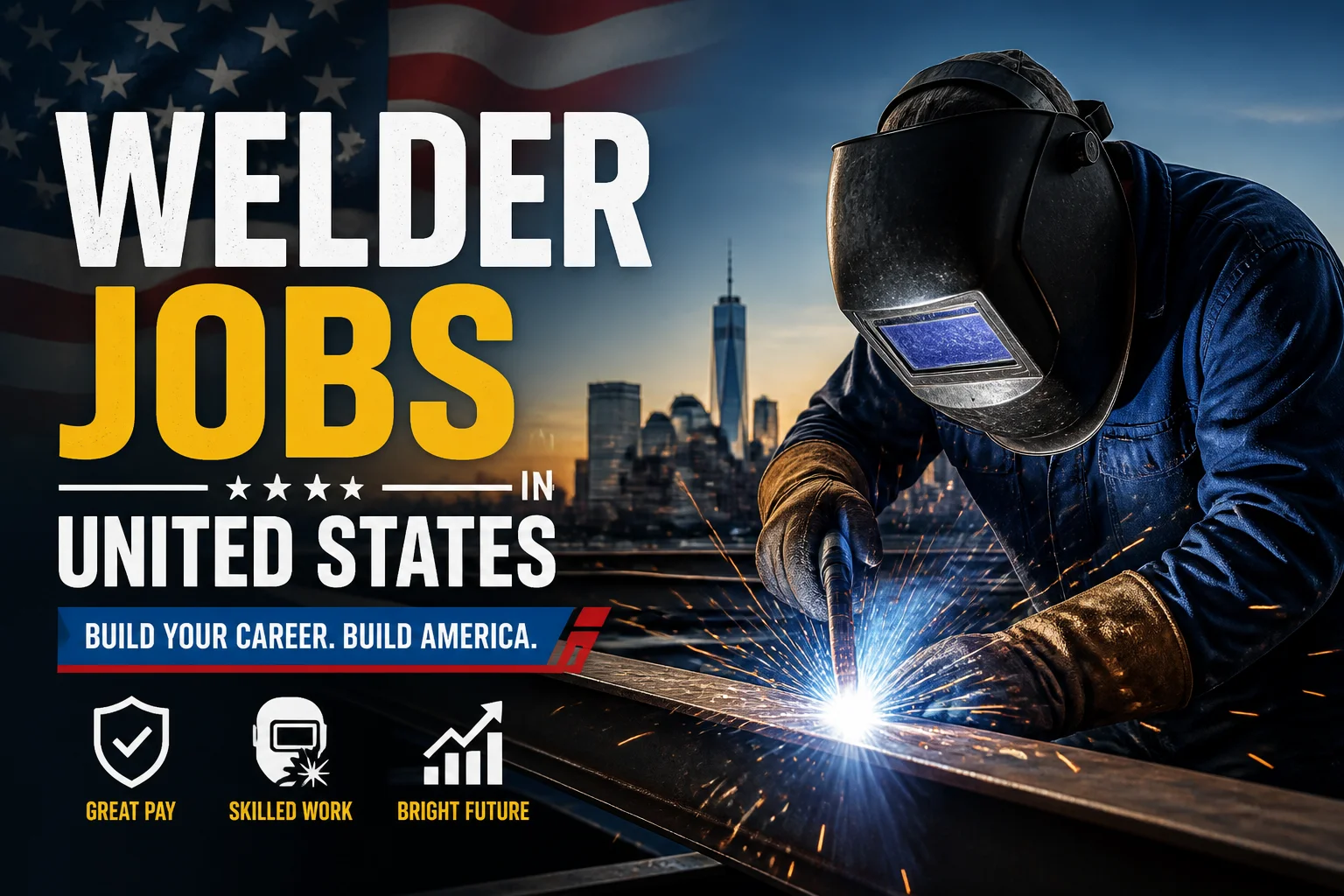
Night shift TIG welder
Company
Express Employment Professionals
Location
Dallas, TX
Job Type
Full-time and Contractor
Posted
3 days ago
Via
via Search Jobs - Express Employment Professionals
Job Description
Hours: First Shift- Monday thru Friday 2nd shift- 2:30pm-11:00pm.
Pay: Based upon experience $24/hr-$27/hr
Position Summary:
• Weld components in flat, vertical, or overhead positions.
• Operate safety equipment and use safe work habits.
• Lay out, position, align, and secure parts and assemblies prior to assembly, using straightedges, combination squares, calipers, and rulers.
• Examine workpieces for defects and measure workpieces with straightedges or templates to ensure conformance with specifications.
• Recognize, set up, and operate hand and power tools common to the welding trade, such as shielded metal arc and gas metal arc welding equipment.
• Weld separately or in combination, using aluminum, stainless steel, cast iron, and other alloys.
• Clamp, hold, tack-weld, heat-bend, grind or bolt component parts to obtain required configurations and positions for welding.
• Select and install torches, torch tips, filler rods, and flux, according to welding chart specifications or types and thicknesses of metals.
• Ignite torches or start power supplies and strike arcs by touching electrodes to metals being welded, completing electrical circuits.
• Connect and turn regulator valves to activate and adjust gas flow and pressure so that desired flames are obtained.
• Determine required equipment and welding methods, applying knowledge of metallurgy, geometry, and welding techniques.
• Monitor the fitting, burning, and welding processes to avoid overheating of parts or warping, shrinking, distortion, or expansion of material.
• Operate manual or semi-automatic welding equipment to fuse metal segments, using processes such as gas tungsten arc, gas metal arc, flux-cored arc, plasma arc, shielded metal arc, resistance welding, and submerged arc welding.
• Analyze engineering drawings, blueprints, specifications, sketches, work orders, and material safety data sheets to plan layout, assembly, and welding operations.
• Mark or tag material with proper job number, piece marks, and other identifying marks as required.
• Weld components in flat, vertical, or overhead positions.
• Operate safety equipment and use safe work habits.
• Lay out, position, align, and secure parts and assemblies prior to assembly, using straightedges, combination squares, calipers, and rulers.
• Examine workpieces for defects and measure workpieces with straightedges or templates to ensure conformance with specifications.
• Recognize, set up, and operate hand and power tools common to the welding trade, such as shielded metal arc and gas metal arc welding equipment.
• Weld separately or in combination, using aluminum, stainless steel, cast iron, and other alloys.
• Clamp, hold, tack-weld, heat-bend, grind or bolt component parts to obtain required configurations and positions for welding.
• Select and install torches, torch tips, filler rods, and flux, according to welding chart specifications or types and thicknesses of metals.
• Ignite torches or start power supplies and strike arcs by touching electrodes to metals being welded, completing electrical circuits.
• Connect and turn regulator valves to activate and adjust gas flow and pressure so that desired flames are obtained.
• Determine required equipment and welding methods, applying knowledge of metallurgy, geometry, and welding techniques.
• Monitor the fitting, burning, and welding processes to avoid overheating of parts or warping, shrinking, distortion, or expansion of material.
• Operate manual or semi-automatic welding equipment to fuse metal segments, using processes such as gas tungsten arc, gas metal arc, flux-cored arc, plasma arc, shielded metal arc, resistance welding, and submerged arc welding.
• Analyze engineering drawings, blueprints, specifications, sketches, work orders, and material safety data sheets to plan layout, assembly, and welding operations.
• Mark or tag material with proper job number, piece marks, and other identifying marks as required.
• Have thorough understanding of TIG Welding fundamentals and operation.
• Must have ability to produce quality welds on a variety of materials as needed.
• Set-up and maintain equipment, settings, gas, choosing proper rod etc.
• Read drawings and measure with gage’s, calipers etc. per instructions.
• Set-up and maintain production consistency, reviewing weld quality, proper fitting and weld techniques.
• Maintain organized, clean work area .
• Operate safety equipment and use safe work habits.
• Assist with other TIG Welders when needed.
Qualifications:
• Possess a minimum of 2 years’ experience in welding in a manufacturing environment or equivalent training/education.
• Has 2 years or more experience with welding Aluminum Sheet Metal.
• Must have considerable knowledge of principles and practices of TIG Welding, effective oral, and written communication skills.
Pay: Based upon experience $24/hr-$27/hr
Position Summary:
• Weld components in flat, vertical, or overhead positions.
• Operate safety equipment and use safe work habits.
• Lay out, position, align, and secure parts and assemblies prior to assembly, using straightedges, combination squares, calipers, and rulers.
• Examine workpieces for defects and measure workpieces with straightedges or templates to ensure conformance with specifications.
• Recognize, set up, and operate hand and power tools common to the welding trade, such as shielded metal arc and gas metal arc welding equipment.
• Weld separately or in combination, using aluminum, stainless steel, cast iron, and other alloys.
• Clamp, hold, tack-weld, heat-bend, grind or bolt component parts to obtain required configurations and positions for welding.
• Select and install torches, torch tips, filler rods, and flux, according to welding chart specifications or types and thicknesses of metals.
• Ignite torches or start power supplies and strike arcs by touching electrodes to metals being welded, completing electrical circuits.
• Connect and turn regulator valves to activate and adjust gas flow and pressure so that desired flames are obtained.
• Determine required equipment and welding methods, applying knowledge of metallurgy, geometry, and welding techniques.
• Monitor the fitting, burning, and welding processes to avoid overheating of parts or warping, shrinking, distortion, or expansion of material.
• Operate manual or semi-automatic welding equipment to fuse metal segments, using processes such as gas tungsten arc, gas metal arc, flux-cored arc, plasma arc, shielded metal arc, resistance welding, and submerged arc welding.
• Analyze engineering drawings, blueprints, specifications, sketches, work orders, and material safety data sheets to plan layout, assembly, and welding operations.
• Mark or tag material with proper job number, piece marks, and other identifying marks as required.
• Weld components in flat, vertical, or overhead positions.
• Operate safety equipment and use safe work habits.
• Lay out, position, align, and secure parts and assemblies prior to assembly, using straightedges, combination squares, calipers, and rulers.
• Examine workpieces for defects and measure workpieces with straightedges or templates to ensure conformance with specifications.
• Recognize, set up, and operate hand and power tools common to the welding trade, such as shielded metal arc and gas metal arc welding equipment.
• Weld separately or in combination, using aluminum, stainless steel, cast iron, and other alloys.
• Clamp, hold, tack-weld, heat-bend, grind or bolt component parts to obtain required configurations and positions for welding.
• Select and install torches, torch tips, filler rods, and flux, according to welding chart specifications or types and thicknesses of metals.
• Ignite torches or start power supplies and strike arcs by touching electrodes to metals being welded, completing electrical circuits.
• Connect and turn regulator valves to activate and adjust gas flow and pressure so that desired flames are obtained.
• Determine required equipment and welding methods, applying knowledge of metallurgy, geometry, and welding techniques.
• Monitor the fitting, burning, and welding processes to avoid overheating of parts or warping, shrinking, distortion, or expansion of material.
• Operate manual or semi-automatic welding equipment to fuse metal segments, using processes such as gas tungsten arc, gas metal arc, flux-cored arc, plasma arc, shielded metal arc, resistance welding, and submerged arc welding.
• Analyze engineering drawings, blueprints, specifications, sketches, work orders, and material safety data sheets to plan layout, assembly, and welding operations.
• Mark or tag material with proper job number, piece marks, and other identifying marks as required.
• Have thorough understanding of TIG Welding fundamentals and operation.
• Must have ability to produce quality welds on a variety of materials as needed.
• Set-up and maintain equipment, settings, gas, choosing proper rod etc.
• Read drawings and measure with gage’s, calipers etc. per instructions.
• Set-up and maintain production consistency, reviewing weld quality, proper fitting and weld techniques.
• Maintain organized, clean work area .
• Operate safety equipment and use safe work habits.
• Assist with other TIG Welders when needed.
Qualifications:
• Possess a minimum of 2 years’ experience in welding in a manufacturing environment or equivalent training/education.
• Has 2 years or more experience with welding Aluminum Sheet Metal.
• Must have considerable knowledge of principles and practices of TIG Welding, effective oral, and written communication skills.
Frequently Asked Questions
Quick answers about Welder Jobs
What is the median hourly wage for welders in the United States as of 2026?
According to the U.S. Bureau of Labor Statistics, the median hourly wage for welders, cutters, solderers, and brazers is $27.50 as of May 2026. The 10th percentile earns $18.75 per hour while the 90th percentile earns $38.20 per hour in the same period.
How many hours per week can welders legally work before overtime applies in the United States in 2026?
The U.S. Department of Labor requires overtime pay at 1.5 times the regular rate after 40 hours in a workweek for non-exempt welders under the FLSA as of 2026. Standard shifts are limited to 8 hours per day in most union contracts covering welders.
What education and certification are required to qualify for welder jobs in the United States in 2026?
The U.S. Bureau of Labor Statistics states that a high school diploma plus a 6-12 month postsecondary welding certificate is the typical entry requirement as of 2026. AWS D1.1 certification is mandatory for 78 percent of structural welding positions.
Which documents are needed to apply for welder positions through official U.S. government workforce channels in 2026?
Applicants must submit Form I-9, state-issued photo ID, and Social Security card to DOL-registered employers as of 2026. Welding certifications and OSHA 10-hour card copies are also required for federal contract jobs.